


Artworks covered nearly every available wall space when the first exhibition opened in Canterbury Museum on 8 February 1870.

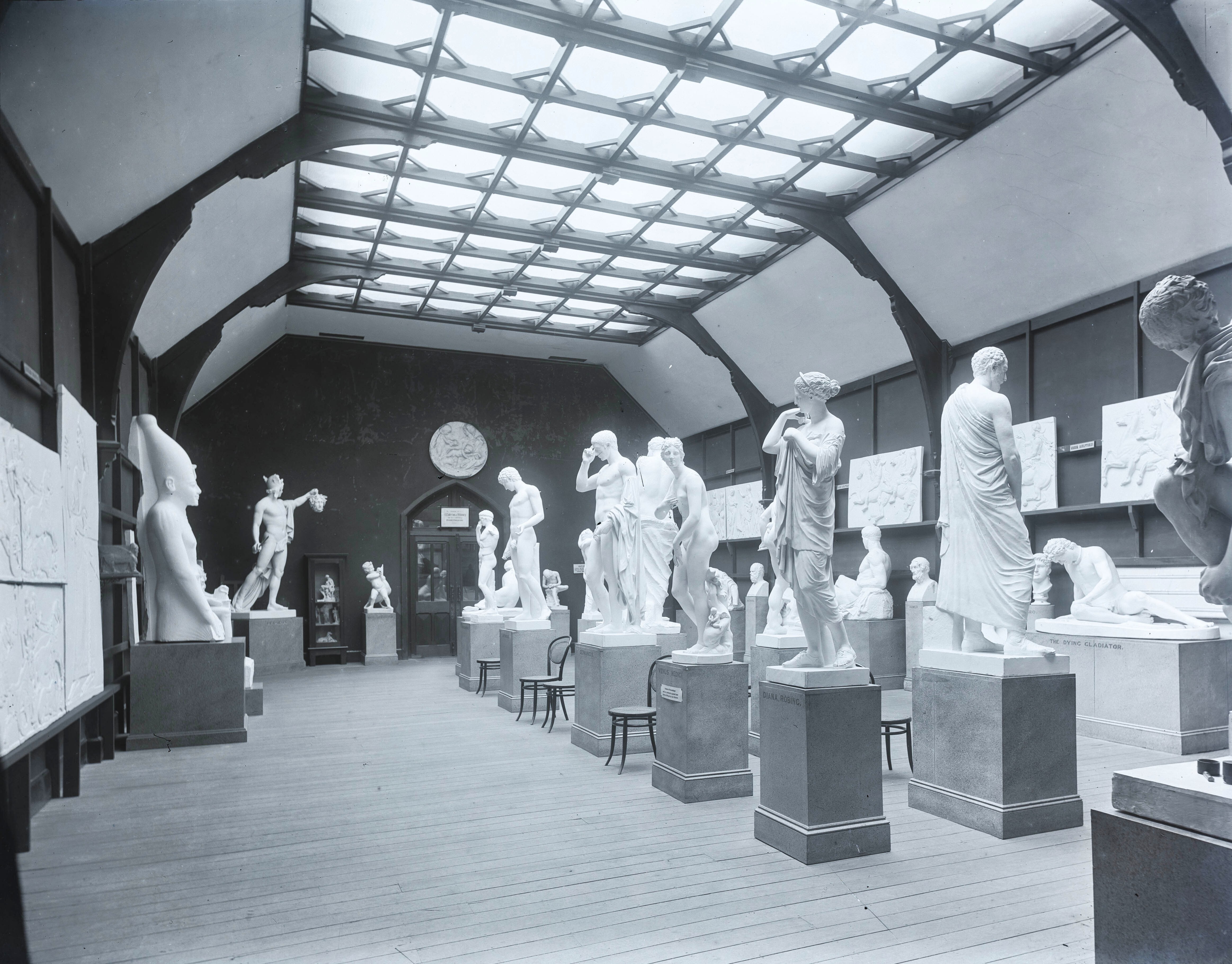
As many as 3,000 artworks crowded the walls of what is now known as the Mountfort Gallery. A series of photographs in the Canterbury Museum collection offer a tantalising glimpse of the scene. The upper level of the Mountfort Gallery is literally packed to the rafters with art. Alongside the paintings were many examples of Greco-Roman and neo-classical art, including casts of famed sculptures depicting Greek heroes and Roman gods in dramatic poses. The inclusion of Greco-Roman artefacts in the Museum’s inaugural exhibition shows how people viewed classical art in the nineteenth century. It reveals how classical art was tied up with taste-making trends, class and the Christchurch social scene. But hidden among the artworks was a forgery.
This cavalcade of art proved incredibly popular. Over the two-month run, 7,000 people flocked to the exhibition. Evening viewings were particularly popular.
On the ground floor of the Mountfort Gallery, visitors encountered manufactured and decorative arts, including photographs, prints, architectural drawings, jewellery, textiles and books, while the upper gallery gave pride of place to watercolours and oil paintings. Most of the classical artworks were casts, including reproductions of famed sculptures like the Läocoon, The Dying Gladiator, Achilles, Venus de Medici, Ariadne, Clytie and Cupid with Psyche.

Underscoring the exhibition was the belief, noted by The Press newspaper, that art would “elevate public taste”. Following the tradition established by the 1851 Great Exhibition of Arts and Industries of All Nations held in London, the organising committee expressed a strong belief in the value of art as a force for enhancing taste and fostering "good" opinions. Nineteenth century European scholarship held Greco-Roman art to be the epitome of aesthetic achievement, so the inclusion of the ‘classical’ was likely expected as necessary to cultivating good taste. These educational aims were sadly undermined by the arrangement of the display. Reviewers lamented that the exhibition was overcrowded, the artworks were out of order and the catalogue was full of mistakes. Each artwork was listed only by its title and the artist's name (where known), leaving little room for interpretation. However, the names of lenders were recorded, reinforcing their status as people with desirable "good taste".

The popularity of the exhibition fostered its own social scene of sorts. A day pass was just 1 shilling, the equivalent of about $3 today. Men and women were encouraged to attend with the evening viewings from 7 pm to 10 pm especially popular. It is hard to say whether the artworks or the social opportunities proved the greater attraction. Alongside the refreshments, a band played most nights, and special musical entertainments featured local amateur performers, including Julius Haast. The arrangements were so congenial that The Press declared, “There is no more intellectual or pleasant an evening to be spent than at the Art Exhibition.”
For those whose primary interest was art, the newspaper reviews focused heavily on landscape paintings by New Zealand artists and barely mentioned the classical works, except to poke fun at painters who adopted a classical style. Still, the classical artworks in the exhibition seem to have had an enduring impact. By 1871, perhaps spurred on by the success of the art exhibition, Julius Haast was publicly campaigning to create a "museum of art" to cater for the needs of art students. By 1873, he had succeeded in acquiring 17 casts of Greek and Roman sculptures for the Museum, using funds donated by George Gould. Among these casts were the Laocoön, the Venus de Medici, and The Dying Gladiator, all of which had appeared in miniature in the 1870 display.
But what about the forgery lurking among the thousands of artworks in the exhibition? The working committee that organised the exhibition knew that Bronze of [a] Roman Emperor was a seventeenth century forgery, but included it in the exhibition anyway. It was shown alongside Greco-Roman artefacts such as a Roman lamp and a lachrymatory vessel, once believed to be a “tear catcher” for mourners but now thought to have been used as a container for perfumes and unguents, an ancient form of ointment.

Once the exhibition closed, the fake Roman emperor and other classical artworks appear to have been returned to their owners. There is again a hint of this in a photograph in the Canterbury Museum collection showing Alfred Charles Barker’s drawing room in 1870. Alfred was a doctor who came to New Zealand on the Charlotte Jane and used his photography skills to document early Christchurch. The photograph includes a pair of classical busts, tastefully arranged on the mantelpiece. The 1870 exhibition committee would have approved.


